


Back in the middle of May I examined what was going on with Jesse Winker for subscribers (and if you aren’t a subscriber – sign up now) and basically, the left handed hitter was hitting an enormous amount of ground balls. From the start of the year through the month of May, Winker had a groundball rate of 62.7%. While he was making contact and draw walks at rates that were strong and in line with his career rates, his power was non-existent, with an isolated power of just .084 (SLG-AVG). It’s tough to find extra-base hits when you are hitting the ball on the ground.
Things began to change in the month of June and since June 1st he’s taken an extreme groundball rate and turns that around, dropping it from nearly 63% down to 43% in the five weeks since the calendar flipped. The increase in balls hit in the air has done wonders for the corner outfielder as he’s hit .327/.416/.486 in the 125 plate appearances over that span of time. His isolated power has jumped up to .159, nearly doubling from the mark from April and May.
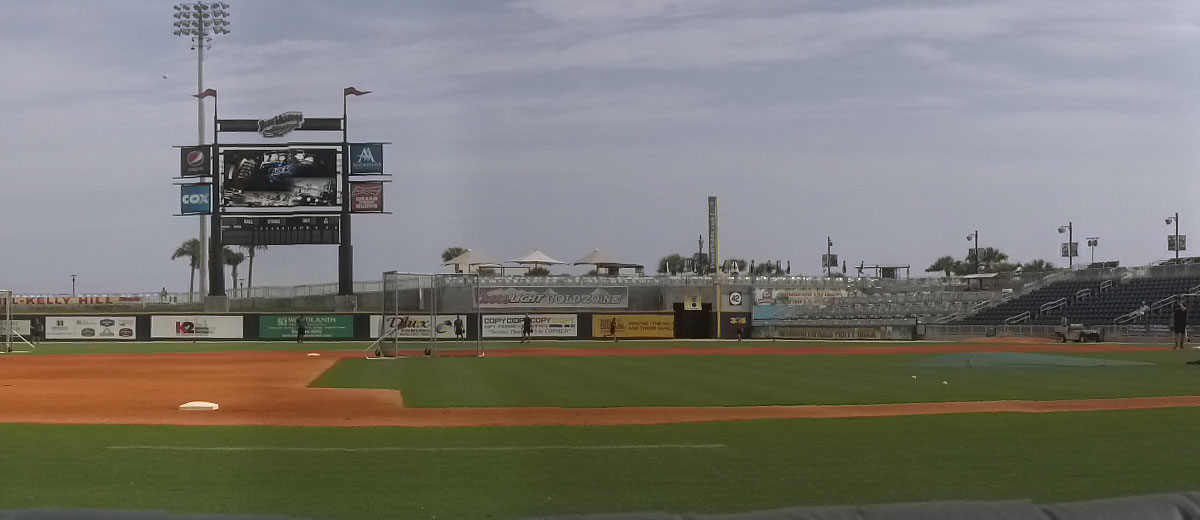
For the season his triple-slash line has improved to .269/.373/.385 with the recent surge. While you expect more power, and it’s certainly been there for late, we shouldn’t forget just how tough it is to hit for power to right field in Pensacola. Winker can and does use the entire field, but every hitter alive has more power to their pull side and Winker is no different in that aspect.
Over the last two seasons Pensacola has suppressed isolated power to right field by .089 and .133. Those are enormous numbers. To put it in a better context, in the 2013 season (I am using this season because I’ve got the full numbers handy) the isolated power on the road in games involving the Pensacola Blue Wahoos both teams combined for a .311 isolated power on baseballs hit to right field. In home games involving the Pensacola Blue Wahoos both teams combined for an isolated power on baseballs hit to right field of just .178.
Baseball America made note earlier this week that one of the reasons that Winker had dropped from their Top 50 prospects list was that they needed to see more power from him given that it’s his bat that will provide the value in his game. And they are right, as a corner outfielder who’s not an elite defender, it is the bat that’s going to carry his value. But the statement also ignored that his home ballpark crushes power to his pull side and that he’s been hitting for solid power over the last six weeks.
The turnaround has been a very good sign for the Reds top position prospect and it’s built on things that should be repeatable moving forward. His groundball/flyball rates have returned to normal, which has in turn allowed him to start hitting for more power. The walk rate remains very strong and his strikeout rate is at 15.7%, an improvement over the rate he posted in the 2014 season. If Winker can just continue to do what he’s been doing for the entirety of his career with the exception of the first two months of 2015 his going to remain as one of the top hitting prospects in baseball.